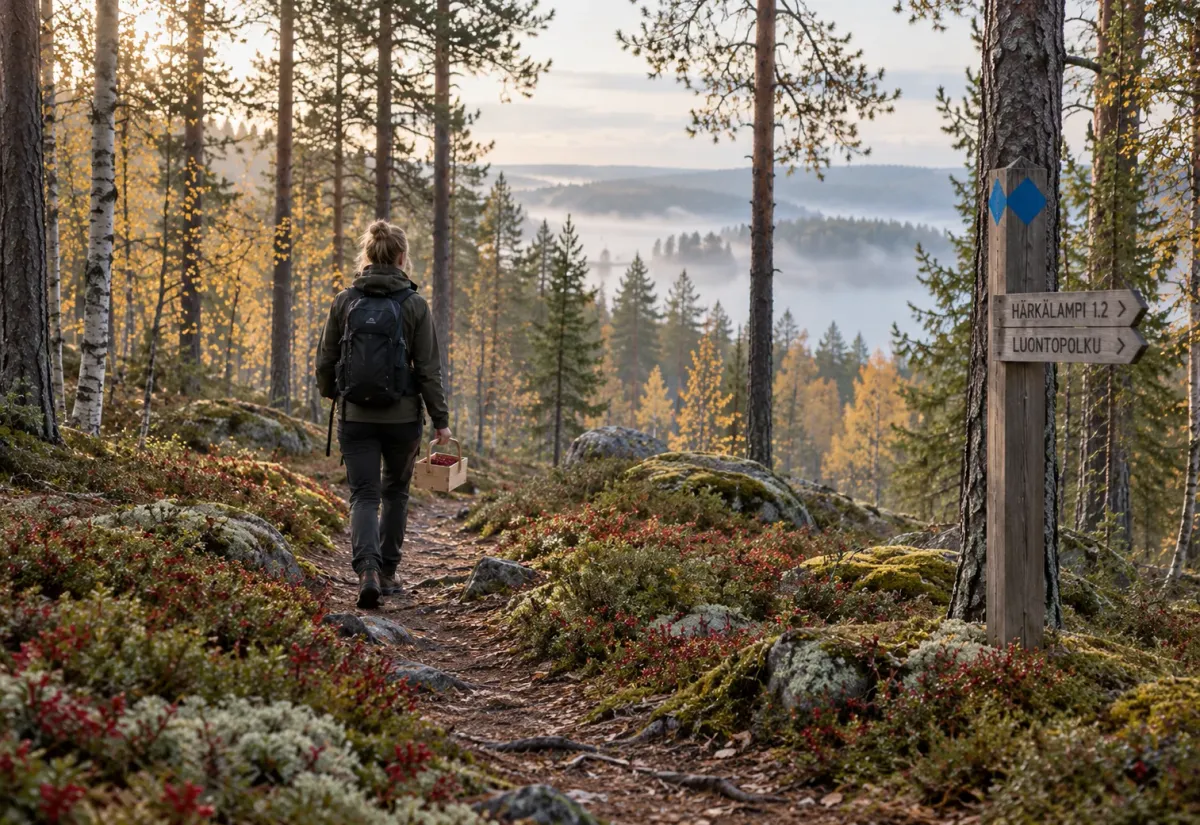
Before a trip, tell someone your planned route and return time, especially in a remote area. A forecast, charged phone, drinking water, and map are sensible preparation even for a short trip. A marked trail reduces getting lost and guides people away from sensitive plants and worn edges. If you meet a gate, close it behind you so grazing animals cannot escape. Keep a dog under control and leashed when needed so it does not chase animals or disturb others.
Amina plans a Saturday outing and notices that national parks and protected areas have their own rules. Before leaving, she decides to check the area website, marked routes, and permitted fire sites. A spring route restriction shown on the site changes Amina’s plan, so she chooses an open trail.
Along the trail, Amina picks a few wild berries because this usually needs no separate permission from the landowner. At a beautiful flower, she stops because she does not know whether the plant is protected or may be collected in this area. Amina photographs the flower and also leaves the trees, moss, and lichen-covered rock untouched.
Litter-free hiking means taking away even small wrappers, tissues, and food scraps. Food left in nature is not harmless; it can change animal behavior and attract pests. Meeting another visitor on a narrow path goes well when you slow down and give safe space. Moving quietly gives others peace and improves your chance of seeing birds and other animals. A careful visitor sees that responsibility does not reduce freedom but helps use it wisely.
The map suggests a shortcut beside cultivated fields, but Amina stays on the marked trail and does not cross a yard. When Amina notices birds’ nests on the ground, she steps back and continues quietly. Later, she hears an engine off road and remembers that everyman’s rights do not normally permit driving there.
As evening approaches, Amina looks for a place where she can stay temporarily and pitch a tent far from homes. She chooses a durable surface so that camping disturbs no one and does not damage vegetation. Amina does not light an open fire on another person’s land; she cooks supper on a camping stove according to the applicable guidance.
In the morning, Amina understands in practice how everyman’s rights open nature to everyone regardless of the landowner. She walks calmly through forests and natural meadows so that her movement causes no harm. On the way home, the accessibility of nature feels valuable, but Amina remembers that freedom always comes with responsibility.
The core can be summed up as: enjoy nature, but leave no harm or lasting trace from your visit. When you consider other people, animals, and the landowner, this broad freedom can remain for future visitors. Responsibility is not the opposite of the right, but the practical condition for keeping nature open and healthy.
One autumn morning, Amina chooses a nearby forest route, packs food, and checks current guidance. On the way, she picks berries into a box but leaves moss, branches, and birds’ nests untouched. On returning, she takes all litter home and sees that she used a broad right without causing harm.
Word bank
Every word as it appears in the text, its base form, what the ending does, and the meaning.
jokaisenoikeus · noun · nominative plural
everyman’s rights
Go to this word in the text
riippua · verb · third infinitive abessive
regardless of
Go to this word in the text
luonnonniitty · noun · adessive plural
in natural meadows
Go to this word in the text
aiheuttaa · verb · present third-person singular negative connegative
cause
Go to this word in the text
saavutettavuus · noun · nominative singular
accessibility
Go to this word in the text
maanomistaja · noun · genitive singular
landowner’s
Go to this word in the text
rauhoittaa · verb · past passive participle nominative singular
protected
Go to this word in the text
jäkälä · noun · partitive singular
lichen
Go to this word in the text
tilapäisesti · adverb · adverb
temporarily
Go to this word in the text
pystyttää · verb · first infinitive
to pitch or erect
Go to this word in the text
leiriytyminen · noun · nominative singular
camping
Go to this word in the text
kasvillisuus · noun · partitive singular
vegetation
Go to this word in the text
avotuli · noun · partitive singular
open fire
Go to this word in the text
toinen · adjective · genitive singular
another person’s
Go to this word in the text
viljelys · noun · genitive plural
cultivated fields’
Go to this word in the text
pesä · noun · nominative plural
nests
Go to this word in the text
maasto · noun · inessive singular
off road or in terrain
Go to this word in the text
suojelualue · noun · adessive plural
in protected areas
Go to this word in the text
tulentekopaikka · noun · nominative plural
designated fire sites
Go to this word in the text
tiivistää · verb · first infinitive
to sum up
Go to this word in the text
Practice
Choose a way to practise this story.
Comprehension quiz
What can you usually do without separate permission from the landowner?
Why should you check a national park’s rules?
What is the reader’s main message?
Fill in the gap
Hän kävelee metsissä ja luonnonniityillä rauhallisesti, jotta kulkeminen ei _____ vahinkoa.
Ennen lähtöä hän päättää _____ alueen verkkosivun, merkityt reitit ja sallitut tulentekopaikat.